Iron deficiency is the most common nutrient deficiency, and at the same time one you should not just buy a jar for. Too much iron is a problem too. Below you can read which signals tell you it is an iron deficiency, who is more likely to have one, what your GP measures, how much iron you need per day, why vitamin C belongs with it and when a supplement makes sense.
Symptoms of an iron deficiency
Iron is needed for haemoglobin, the part of the red blood cells that carries oxygen through your body. With a deficiency you notice that, according to the Netherlands Nutrition Centre, by:
- Tiring quickly
- Pale skin
- Getting out of breath quickly
- Restless legs, an urge to move them
The most serious form is anaemia. The complaints are often there before it gets that far. If you have these complaints for a longer period, see your GP. They test haemoglobin and usually ferritin too, the measure of your iron store. A low ferritin value with a still normal haemoglobin is the early stage: the store is empty, but the blood is not yet. The thresholds differ per laboratory and per situation, so discuss the result with your GP instead of comparing it with a number from the internet.
Who is more likely to have an iron deficiency?
For most people the chance of an iron deficiency is not great. Your body takes more iron from food itself when a deficiency threatens. There are groups at extra risk:
- Women of childbearing age, through blood loss during menstruation. This is by far the largest group.
- Pregnant and breastfeeding women.
- Young children, who need iron for the development of thinking ability and muscle coordination.
- Vegetarians and vegans: they sometimes have lower iron stores, but usually still enough. The Nutrition Centre sees no reason to recommend more iron for vegetarians, but does advise watching the intake.
Other causes are blood loss you do not see, from the stomach or bowels for instance, and conditions that disrupt absorption. That is why an iron deficiency in men and in women after the menopause is always a reason to investigate the cause, not just to top up.
How much iron per day?
The recommended daily amount is 11 milligrams for men and for women after the menopause, and 16 milligrams for women from 18 until the menopause, during pregnancy and when breastfeeding. Children: 8 milligrams at age 1 to 3, 7 milligrams from 4 to 6, 11 milligrams from 7 to 17, and 13 milligrams for girls from 12 to 17.
There is no tolerable upper level for iron, but there is a safe level of intake: 40 milligrams a day for adults. Above 45 milligrams, acute stomach and bowel complaints can occur, such as nausea, vomiting and diarrhoea. In the longer term too much iron is harmful to the liver. People with the hereditary condition haemochromatosis, about half a per cent of the population, store iron and must certainly not take iron tablets.
Where is iron found?
There are two kinds. Haem iron is found only in animal products (meat, fish, chicken) and is absorbed well. Non-haem iron is found in bread and wholegrain products, pulses, nuts, green vegetables, eggs and meat substitutes, and is absorbed less well. A few portions:
- A piece of cooked beef (75 grams): 2.7 milligrams, of which 1.7 haem iron
- A slice of cooked tofu (75 grams): 1.7 milligrams
- A handful of unsalted cashew nuts (25 grams): 1.7 milligrams
- A serving spoon of cooked spinach (70 grams): 1.7 milligrams
- A serving spoon of red kidney beans (60 grams): 1.4 milligrams
- A boiled egg (50 grams): 1.2 milligrams
- A slice of wholemeal bread (35 grams): 0.7 milligrams
Why vitamin C belongs with it
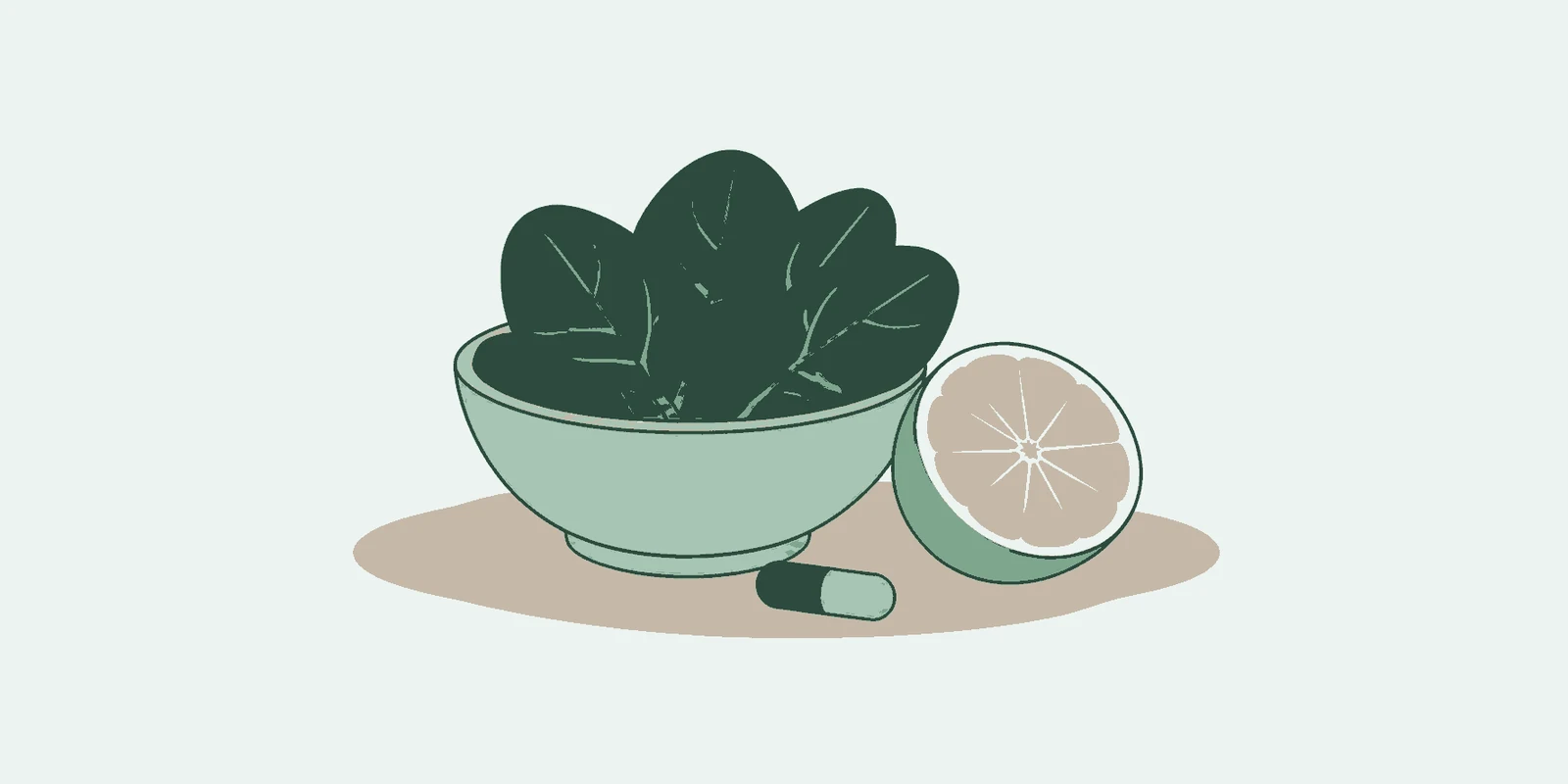
Vitamin C increases iron absorption. That is an approved claim, and it applies above all to non-haem iron from plant-based food. Vegetables or fruit with every meal is therefore no detail: it determines how much of the iron on your plate actually gets in. The other way round, phytate (in grains and pulses) and the polyphenols in tea and coffee work against it. Calcium slows absorption a little; that effect is small and according to research does not lead to deficiencies, but anyone taking an iron supplement does take it into account.
In practice: take iron on an empty stomach or with a light meal, with a glass of orange juice or a vitamin C capsule, and keep coffee, tea and dairy a few hours away. The combinations that do and do not work are listed in which vitamins can you take together. How much vitamin C you need per day is in vitamin C deficiency: symptoms and how much per day.
When an iron supplement, and how much?
The advice of the Nutrition Centre is clear: do not take multivitamins or other supplements with iron if there is no reason to. A varied diet provides enough for most people. If there is a reason, you keep to at most 100 per cent of the recommended daily amount from a supplement: 11 milligrams for men and women after the menopause, 16 milligrams for women of childbearing age, pregnant women and when breastfeeding.
Once a deficiency is proven, your GP usually prescribes a higher dose, temporarily and with monitoring. That is a different situation from topping up yourself. Iron tablets in those doses can upset the stomach and colour the stool dark; the latter is harmless. With complaints you consult the pharmacy about the timing or another form.
If you want to top up on your own initiative, for instance because you lose a lot of blood during menstruation or eat little meat, the Gentle Iron by Together is a mild form: 16 milligrams of iron per capsule, from curry leaf, in a plant-based capsule. That is exactly the recommended amount for women of childbearing age, and more than the 11 milligrams for men and women after the menopause; for those groups topping up without a proven deficiency is not the idea. The manufacturer advises taking it without food, with a small glass of orange juice, and no coffee or calcium-rich food three hours before or after. Iron contributes to the reduction of tiredness and fatigue, to normal oxygen transport in the body and to normal formation of red blood cells and haemoglobin.
If the complaints persist after a few months, or come back after stopping, see your GP after all. An iron deficiency has a cause, and that does not go away by topping up.
Frequently asked questions about iron deficiency
What are the symptoms of an iron deficiency?
Tiring quickly, pale skin, getting out of breath quickly and restless legs. The most serious form is anaemia. Your GP establishes it with a blood test for haemoglobin and ferritin.
What does a low ferritin mean?
Ferritin is the measure of your iron store. A low value means the store is empty, even if your haemoglobin is still normal. The threshold differs per laboratory; your GP interprets the result.
How much iron per day do you need?
11 milligrams for men and women after the menopause, 16 milligrams for women until the menopause, pregnant women and when breastfeeding. From a supplement you take no more than that amount, unless your GP prescribes otherwise.
When is it best to take iron?
On an empty stomach or with a light meal, with something rich in vitamin C. No coffee, tea or dairy in the hours around it. If it sits heavily on the stomach, take it with food after all; a little less absorption is better than stopping.
Can you solve an iron deficiency with food?
With a slight drop in the store, more iron-rich food with vegetables or fruit helps. With a proven deficiency, food alone is usually too slow; then your GP decides the top-up.
Do vegetarians get an iron deficiency?
Not automatically. Vegetarians often have somewhat lower stores, but usually still enough. Watch for iron-rich meat substitutes, pulses and wholegrain, and take vitamin C with them for absorption.