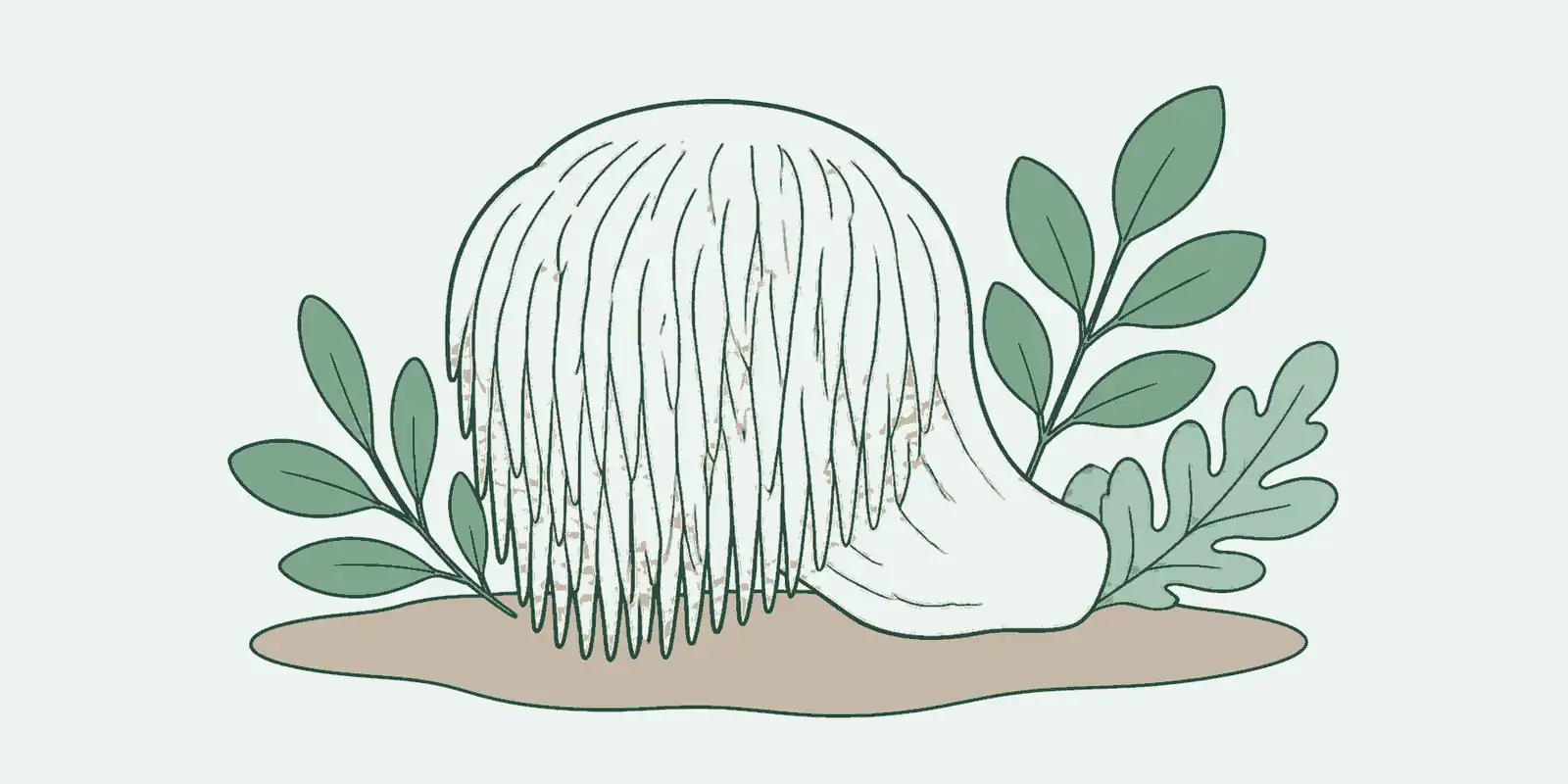
Lion’s Mane is an edible mushroom that has been gaining a lot of popularity as a food supplement in recent years. Its Latin name is Hericium erinaceus. You recognise it straight away by the white, shaggy strands that call to mind a lion’s mane. In this blog you can read what Lion’s Mane is exactly, where it comes from, what is in it and how you use it.
What is Lion’s Mane?
Lion’s Mane grows naturally on deciduous trees such as beech and oak, mainly in Asia, North America and parts of Europe. The mushroom does not have a cap with gills like the one you know from a button mushroom, but hanging white spines. It owes its English name Lion’s Mane to that appearance.
These days Lion’s Mane is also grown under controlled conditions, which makes it available as a supplement all year round. At Dutch Balance we offer Lion’s Mane in capsule form from the brand Pure Mushrooms.
Fresh, home-grown or as a supplement?
Search for lion’s mane and you quickly end up at growers, fresh mushrooms sold by the 200 grams, and wooden dowels to grow it yourself on a log. That is no accident: lion’s mane is also simply a culinary mushroom, with a firm texture and a mild taste.
We do not sell fresh lion’s mane and we do not sell growing kits. What we carry are capsules with powder from the whole fruiting body. That is a different form with a different purpose: not an ingredient for the pan, but a fixed daily amount you do not have to prepare.
If you want to taste it, look for a grower near you. If you want it as a supplement, read on.
How has Lion’s Mane traditionally been used?
In East Asia, Lion’s Mane has been part of the kitchen and the herbal tradition for centuries. The mushroom was used in teas and soups and had a place in traditional Chinese herbalism. In Japan it goes by the name yamabushitake, after the mountain monks who knew the mushroom.
That long history is one of the reasons Lion’s Mane is now getting so much attention in the West as well. It is worth knowing that traditional use is something other than scientific proof.
What is in Lion’s Mane?
Lion’s Mane contains a number of compounds that make it interesting to researchers. The best known are hericenones and erinacines, two groups of compounds found mainly in this mushroom. Lion’s Mane also contains beta-glucans: complex sugars you come across in more mushrooms.
These compounds help determine the character of the mushroom. What exactly they do in the body is still very much the subject of research.
Lion’s Mane and research
Compounds from Lion’s Mane are being looked at scientifically, among other things in relation to the nervous system. That research is still at an early stage and has largely been carried out in the lab or in animals. There are no hard conclusions for humans yet.
Lion’s Mane is a food supplement, not a medicine and not a replacement for a healthy lifestyle or medical care. Do you take medication, are you pregnant or breastfeeding? Then consult your doctor first.
Online you will come across far more emphatic stories, especially about memory and concentration. That certainty is not covered by what is known today. We do not join in, and that is not modesty but the rule: there are no EU-approved health claims for lion’s mane.
How to use Lion’s Mane
The simplest way to fit Lion’s Mane into your routine is in capsule form. You take our Pure Mushrooms capsules with a sip of water. Stick to the dose on the packaging, 1 to 2 capsules a day.
Choose a fixed moment, at breakfast or lunch for instance. That way you make a habit of it and are less likely to forget. Would you like to try it out? Then feel free to start with one capsule a day to see how you get on with it.
How much is in a capsule?
With mushroom supplements the number of milligrams says little on its own. What counts is where the powder comes from. Powder from the fruiting body is something other than mycelium grown on grain, because the latter contains a fair share of grain residue.
That is why the Pure Mushrooms packaging states which part of the mushroom the powder comes from. If you are comparing two jars, look at that first and at the milligrams second.
Lion’s Mane side effects: is Lion’s Mane safe?
Lion’s Mane is generally well tolerated. The side effects that get mentioned are mild: stomach complaints, or an allergic reaction in anyone sensitive to mushrooms. Beyond that, there are two points to keep in mind:
- Use during pregnancy or breastfeeding is not advised.
- Do you take medication or have a medical condition? Consult your doctor first.
Stick to the dose on the packaging and start low, so you notice how your body responds.
What should you look for in terms of quality?
Not every mushroom supplement is the same. With Lion’s Mane, pay attention to these points:
- Powder or extract from the whole fruiting body (the mushroom itself), not only from mycelium on grain.
- Organically grown, without unnecessary additions.
Our Pure Mushrooms Lion’s Mane is EU organic certified and made from the whole fruiting body. Want to know more or order straight away? Have a look at the Lion’s Mane capsules or our full range of mushrooms.
Buying Lion’s Mane? Have a look at the organic Lion’s Mane capsules from the whole fruiting body.
Frequently asked questions about Lion’s Mane
What is Lion’s Mane good for?
That is something we are not allowed to say. No health claims have been approved for Lion’s Mane in the European Union, and research into the substances it contains is still at an early stage. What we do know: Lion’s Mane (Hericium erinaceus) is an edible mushroom that has been used for centuries in East Asia in teas, soups and herbal tradition.
Does Lion’s Mane have any downsides?
Lion’s Mane is generally well tolerated. The side effects that are mentioned are mild: stomach complaints, or an allergic reaction in people who are sensitive to mushrooms. Use during pregnancy or breastfeeding is not recommended, and if you take medication or have a medical condition, talk to your doctor first.
Has there been scientific research into Lion’s Mane?
Yes. Researchers mainly look at hericenones and erinacines, two groups of compounds found mostly in this mushroom. That research is still at an early stage and has largely been done in the lab or on animals, so there are no firm conclusions for humans. That is why there are no approved health claims for Lion’s Mane.
How much Lion’s Mane per day?
Follow the dosage on the packaging and start low, for example with one capsule a day to see how it suits you. Take the capsules with a sip of water at a fixed moment, such as with breakfast or lunch, so you are less likely to forget.