Anyone looking for CBD oil for the first time ends up facing a wall of bottles that all look roughly the same. Brown glass, a pipette, a percentage on the label. Prices range from a tenner to well over a hundred euros, and why that is, is rarely stated.
This page explains what CBD oil is: what is in it, what those percentages mean, how the types differ and how you tell them apart. By the end you can put two bottles side by side and see exactly what you are looking at.
What is CBD?
CBD stands for cannabidiol. It is one of the more than a hundred cannabinoids that occur naturally in the hemp plant, Cannabis sativa. The best-known other cannabinoid is THC, and that is immediately the most important distinction: THC is the compound that gives the high effect, CBD is not.
Hemp is an old crop with many faces. The same plant species provides rope, insulation material, bird feed and textiles. For CBD a variety is grown that produces a lot of cannabidiol and virtually no THC. An extract is then obtained from the flowers and the leaves, usually with CO2 under high pressure. That extract is the basis of every bottle.
What is in the bottle?
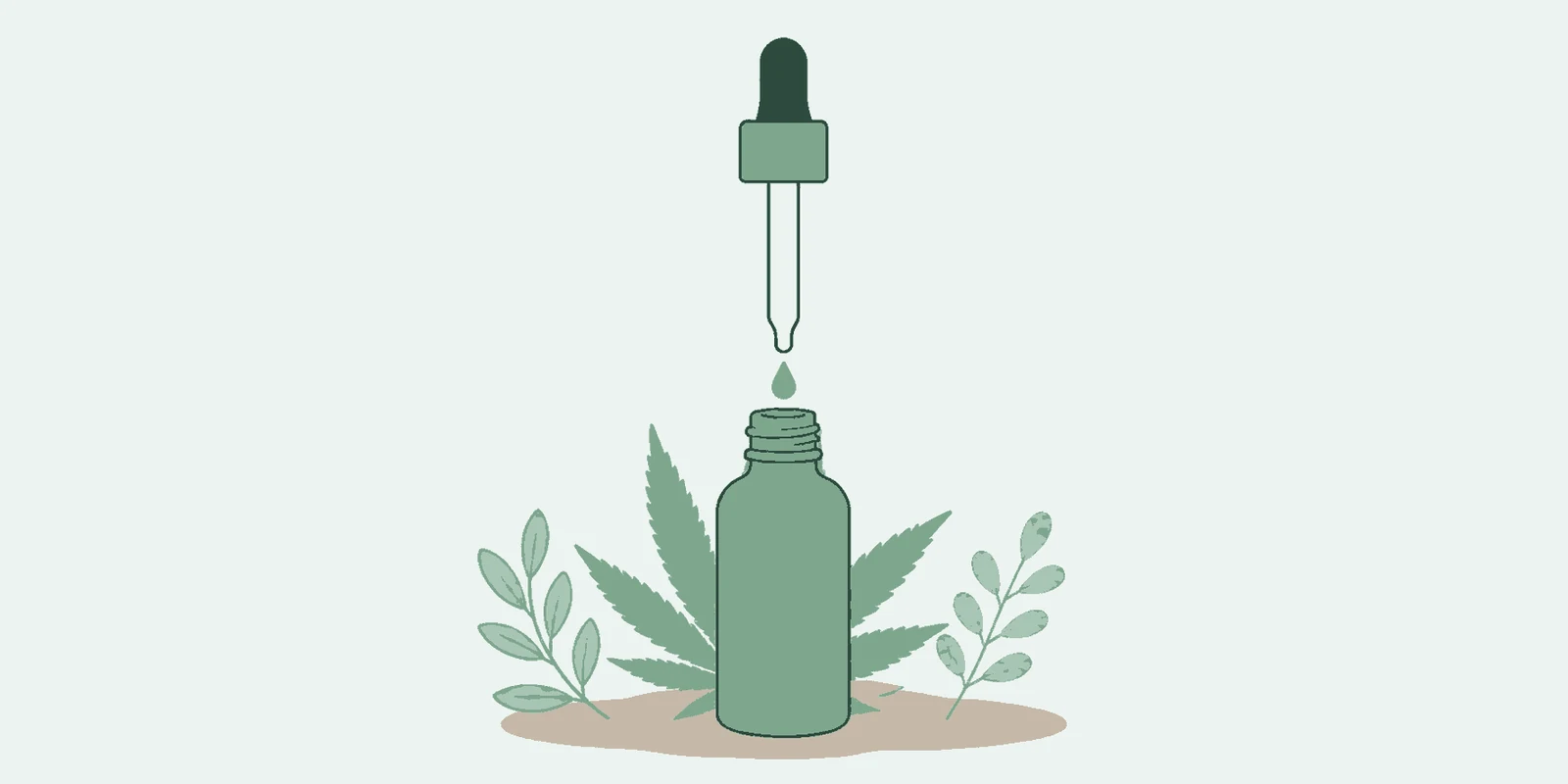
Essentially two things: the hemp extract, and an oil in which that extract is dissolved. The second is not a filler to make the bottle look full. CBD does not dissolve in water but does dissolve in fat, so without a carrier oil you have no usable product.
Two carrier oils are the ones you come across most. MCT oil is obtained from coconut, is thin and virtually tasteless, and stays clear. Hemp seed oil is pressed from the seeds of the same plant, is thicker and has a pronounced nutty taste you have to like. There can also be a flavouring in it, or a terpene profile. Terpenes are the aromatic compounds of plants, the same kind of compounds that give pine needles and citrus peel their smell.
Watch out for one confusing point: hemp seed oil in itself contains no CBD. Seeds do not produce that compound. A bottle that says “hemp oil” in large letters and states no CBD content anywhere is therefore a different product from CBD oil, even though it sits on the same shelf. So always check whether there is a number of milligrams on the label.
What do those percentages say?
The percentage indicates how much CBD there is in proportion to the rest of the contents. More practical is the conversion to milligrams, because that is what you ultimately dose with. A 10 ml bottle contains about 250 drops, and that makes the sums simple.
| Strength | CBD in 10 ml | Per drop | Drops for 10 mg |
|---|---|---|---|
| 2.5% | 250 mg | 1 mg | 10 |
| 5% | 500 mg | 2 mg | 5 |
| 10% | 1000 mg | 4 mg | 2 to 3 |
| 15% | 1500 mg | 6 mg | almost 2 |
| 20% | 2000 mg | 8 mg | just over 1 |
What follows straight away: a more expensive 20% bottle can be cheaper per milligram than a cheap 5% bottle. If you want to compare two products fairly, divide the price by the number of milligrams of CBD. That figure says more than the price on the shelf.
A higher strength is therefore not automatically a better buy. It only helps you if you actually use that strength, and with a strong oil you soon end up counting in half drops. Anyone who wants to start low is more precise with a lower percentage. Strengths above 20% exist too, up to about 25%, but that is firmly territory for anyone who knows exactly what they are looking for. In how strong should my CBD oil be we go into that in more depth.
Full spectrum, broad spectrum or isolate?
These three words are all about the same question: how much of the original plant is left in the extract?
Full spectrum keeps the complete palette. Alongside CBD there are other cannabinoids in it, plus terpenes and other plant compounds, including the legally limited trace of THC. Such an oil is dark in colour and herbal in taste, because you taste the plant.
Broad spectrum is basically the same, but with the THC taken out. For anyone who, for whatever reason, wants no THC at all, that is the middle way: you keep most of the plant compounds, without the trace.
Isolate is pure CBD, separated from everything else. The result is a white crystalline powder that then goes into the carrier oil. Colourless, odourless and tasteless, and therefore the most neutral of the three.
So from colour and taste you can see and taste straight away what you are dealing with. A clear, tasteless oil is almost certainly an isolate. How to make that choice is set out in more detail in broad spectrum and full spectrum explained, and the entourage effect covers the thinking behind the complete plant palette.
Does CBD oil get you high?
No. The high effect comes from THC, and that is a different compound from CBD. The oil you simply buy in a shop or webshop in the Netherlands stays well below the limit at which THC plays any meaningful role. With our products the THC content is below 0.05%.
That also makes CBD oil something other than cannabis oil, even though people use those words interchangeably. Cannabis oil is made from plants that have been grown for a high THC content. That is a different product, with a different legal status. The full distinction is set out in CBD oil vs cannabis oil. If you get into a car regularly, also read CBD and driving, because separate rules apply there.
How do you use CBD oil?
The usual way is with the pipette, under the tongue. You squeeze the number of drops you want under your tongue and let them sit there for half a minute to a minute before you swallow. The mucous membrane under the tongue absorbs fat-soluble compounds, so you partly skip the detour through the stomach and liver. That is exactly why waiting that minute is not a ritual but half the story.
How much you take is personal and is in no table anywhere. Many users start low, with two drops for instance, and keep that up for a few weeks before they change anything. That is practical too: if you change everything at once, you cannot tell afterwards what was what. A fixed moment in the day helps more than a loose habit, because most people do not trip over the dose but over forgetting.
Using drops is, incidentally, not the only form. There are capsules with a fixed amount each and no taste, and there are patches and edible variants. The taste of a full spectrum oil is for some people the reason to switch. Which form is the right one depends mainly on what you will still be using in three months.
Store it cool, dark and with the cap firmly closed. Light and heat are the two things plant oil copes badly with, so the kitchen cupboard beats the windowsill. More about that in storing CBD oil.
What do you look out for when choosing?
Five things make the difference between two bottles that look identical in the webshop.
- A lab report per batch. An independent laboratory measures what is really in it, and whether that matches what is on the label. If you cannot find that report anywhere, ask for it. A seller who cannot supply it does not know either.
- A complete ingredient list. Extract, carrier oil and whatever else is in it. If that list is missing, you are buying a percentage and nothing more.
- Origin and extraction method. Where the hemp was grown and how the extract was obtained. That says something about how verifiable the chain is.
- Price per milligram. Not the price on the shelf, but the sum from the table above.
- The form you keep up. The best oil is the oil that is not sitting half-full at the back of a drawer in three months.
Would you like to make that comparison straight away? Then have a look at our range of CBD oil. If you are looking for help choosing between brands and strengths, which CBD oil suits you will help you further.
What you deliberately do not read here
You will find nothing on this page about what CBD would do in your body. That is not caution born of ignorance, it is the rule. Since 2019 the European Commission has classed CBD extract as a novel food, and not a single health claim has been approved for it. Anyone who does promise you something about sleep, stress or pain is not keeping to that rule.
For a webshop that is an awkward rule, because it is exactly what people are looking for. Even so, it is not so strange: a product that did everything claimed about it online would be a medicine, and then you would get it from the pharmacy and not from us.
So what we can do, we do as fully as possible. Telling you what is in the bottle, where it comes from, what the lab report says and how you use it. The rest we leave to you, and where your health is concerned, to your doctor.
Frequently asked questions
Is CBD oil the same as cannabis oil?
No. Cannabis oil is made from plants with a high THC content. CBD oil comes from hemp that has been grown for a low THC content. They are two different products with a different legal status.
Is there THC in CBD oil?
In a full spectrum oil there is a trace. With our products that stays below 0.05%. In broad spectrum and isolate the THC has been taken out.
How many drops are there in a 10 ml bottle?
About 250. With a 5% oil that comes down to around 2 mg of CBD per drop, with 10% to about 4 mg. That is how you convert a percentage into milligrams.
Can I combine CBD with medicines?
Discuss that with your doctor or pharmacist. CBD can influence the way your body breaks down certain medicines. Which interactions can play a role is set out in our article about CBD and medicines.
How long does a bottle keep?
Check the label for the best before date. After opening, storing it cool and dark matters more than that date, because light and heat break down plant oil.
Where do I start if I have never used it?
With a low strength and a small bottle. Trying it out then costs little and you can always move to a higher strength later. Handy to read beforehand: the nine most common misconceptions about CBD.
Further reading
- How strong should my CBD oil be?
- Broad spectrum and full spectrum explained
- What is the entourage effect?
- CBD oil or capsules?
- Storing CBD oil
- The 9 most common misconceptions about CBD
This article is informative and not medical advice. For complaints or questions about your health, consult your doctor or another healthcare professional. Do not use during pregnancy, breastfeeding or alongside medication without consulting a doctor.