Medicinal mushrooms have been used for thousands of years in herbal traditions all over the world. These fungi contain a wide range of bioactive compounds and have been popular as food supplements in recent years. At Dutch Balance we offer mushroom supplements from the brand Pure Mushrooms.
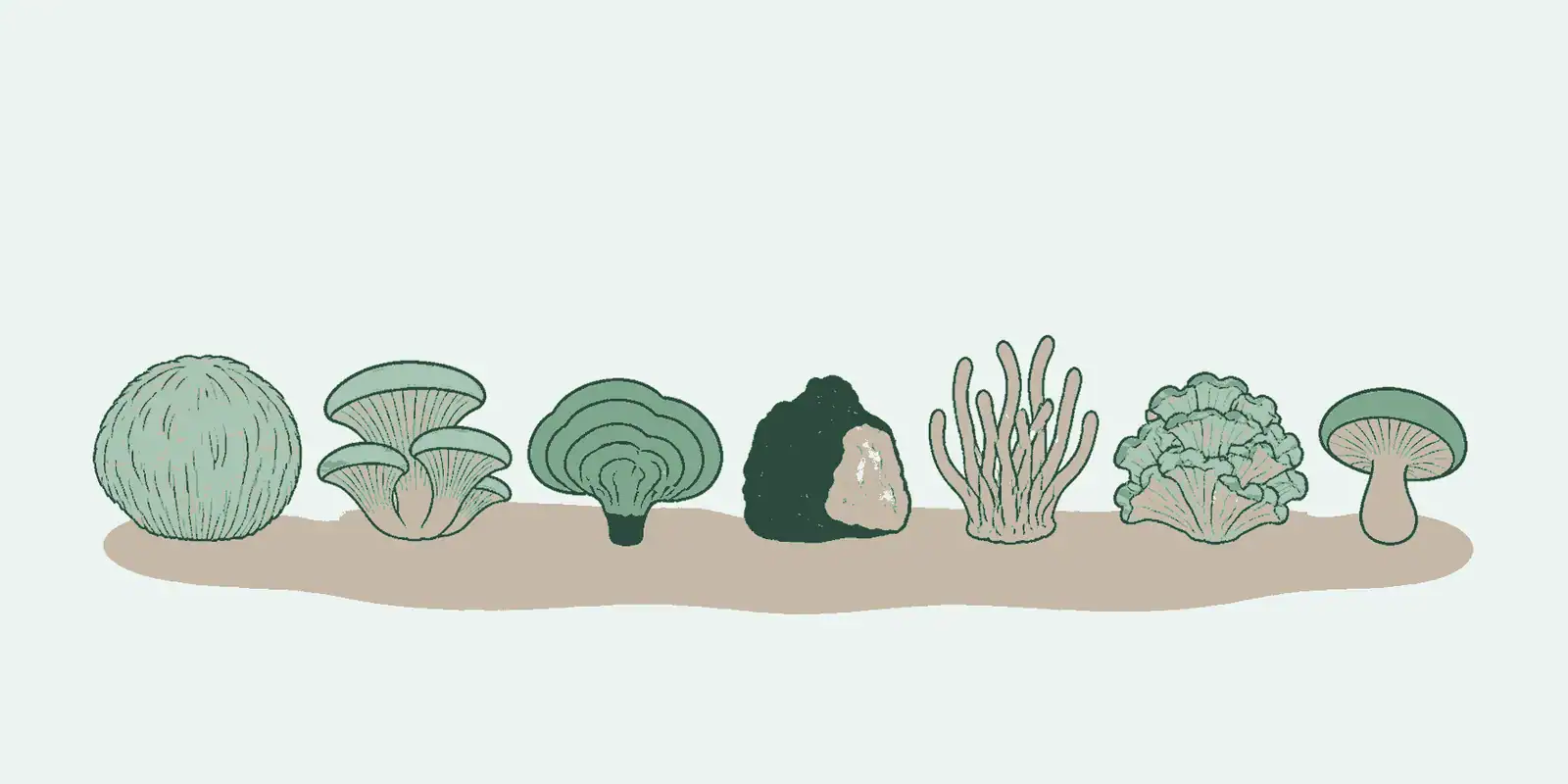
In this article you get to know seven well-known mushrooms: what they are, where they come from and what is in them.
1. Lion’s Mane
Lion’s Mane (Hericium erinaceus) owes its name to its appearance: white, shaggy strands that call to mind a lion’s mane. In the wild the mushroom grows mainly on deciduous trees.
In traditional Chinese herbalism Lion’s Mane has been used for centuries, especially in teas and soups.
Characteristics of Lion’s Mane:
- Contains hericenones and erinacines, two groups of compounds found mainly in this mushroom.
- Contains beta-glucans, a type of polysaccharide.
- Also known as the lion’s mane mushroom or bearded tooth fungus.
- Traditionally used in teas and soups.
2. Reishi: the glossy mushroom
Reishi (Ganoderma lucidum) has a characteristic glossy, lacquered look. In China this mushroom is known as ‘Lingzhi’. It has been used in East Asia for more than two thousand years and contains hundreds of bioactive compounds.
Characteristics of Reishi:
- Contains polysaccharides and triterpenes, including ganoderic acid.
- Recognisable by its bitter taste.
- Chinese honorific name: Lingzhi.
- Traditionally used in teas and infusions.
3. Chaga: the birch conk
Chaga (Inonotus obliquus) is a hard mass that grows on birch trees in cold climates such as Siberia and Northern Europe. In Russia Chaga has been used in folk medicine for centuries, often as a tea.
Characteristics of Chaga:
- Contains a high concentration of antioxidants that occur naturally in the mushroom.
- Rich in betulinic acid, a compound from birch bark.
- Contains the enzyme SOD (superoxide dismutase).
- Also known as the birch conk.
4. Cordyceps: the high-altitude mushroom
Cordyceps grows naturally on the Tibetan plateau, at altitudes between 3000 and 5000 metres. Because of its scarcity, wild Cordyceps sinensis is one of the most expensive mushrooms in the world. These days cordyceps is grown under controlled conditions, among other things for our Pure Mushrooms capsules.
Characteristics of Cordyceps:
- Contains cordycepin and polysaccharides.
- Grows naturally at high altitude in the Himalayas.
- Traditionally part of the Tibetan and Chinese herbal tradition.
- Is grown under controlled conditions these days.
The four side by side
If you are searching for “chaga reishi cordyceps”, you probably want to see them next to each other. This is what factually sets them apart: where they come from and in which form we carry them.
| Mushroom | Latin name | Where it grows | With us |
|---|---|---|---|
| Lion’s Mane | Hericium erinaceus | On hardwoods such as beech and oak | 60 capsules |
| Reishi | Ganoderma lucidum | On wood, traditionally in East Asia | 60 capsules |
| Chaga | Inonotus obliquus | On birch in cold climates | 60 capsules |
| Cordyceps | Cordyceps militaris | Originally in high mountain regions | 60 capsules |
What we do not do is say which mushroom is for what. There are no EU-approved health claims for these species, and the assertions you come across online are not covered by what is known today. What we can say: they differ in origin, in the compounds they contain and in their tradition.
If you cannot decide, there are two blends combining several species. That saves choosing. See the full range under mushrooms.
5. Maitake: hen of the woods
Maitake (Grifola frondosa) is known in English as hen of the woods. The name Maitake comes from Japanese and means ‘dancing mushroom’. This mushroom contains various nutrients, including potassium, calcium, magnesium and B vitamins.
Characteristics of Maitake:
- Contains beta-glucans and heteroglycans.
- Source of potassium, calcium, magnesium and B vitamins.
- Low in calories and rich in fibre.
- Also known as hen of the woods.
6. Shiitake: the culinary mushroom
Shiitake (Lentinula edodes) is one of the most widely cultivated edible mushrooms in the world and a fixture in Asian cooking. It is rich in nutrients: all eight essential amino acids, B vitamins, minerals, and it is one of the few plant-based sources of vitamin D.
Characteristics of Shiitake:
- Contains lentinan, a polysaccharide.
- Source of vitamin D, which contributes to the maintenance of normal bones.
- Contains all eight essential amino acids.
- Widely used in Asian cooking.
7. Turkey Tail
Turkey Tail, in Latin Trametes versicolor, owes its name to the colourful rings that call to mind a turkey’s tail. This mushroom contains the bioactive compounds polysaccharide-K (PSK) and polysaccharide-peptide (PSP).
Characteristics of Turkey Tail:
- Contains the polysaccharides PSK and PSP.
- Contains prebiotic fibres.
- Naturally contains various antioxidants.
- Also known as the many-zoned polypore.
Frequently asked questions about medicinal mushrooms
How do medicinal mushrooms work?
We are not allowed to say. There are no EU-approved health claims for these mushrooms, and much of the research is still at an early stage. What is established: they have been used for thousands of years in herbal traditions, including in China, Tibet and Russia. They are food supplements, not medicines.
Which healing mushrooms are there?
We do not call them healing, because they are food supplements. Well-known species are Lion’s Mane, reishi, chaga, cordyceps, maitake, shiitake and turkey tail. At Dutch Balance you will find Lion’s Mane, reishi, chaga and cordyceps from Pure Mushrooms, plus two blends that combine several species.
What is the healthiest mushroom?
We do not make that ranking, because we do not say which mushroom is for what. What we can say: they differ in origin, in the substances they contain and in their tradition. Reishi contains triterpenes, for example, cordyceps contains cordycepin and shiitake is a staple of Asian cooking.
What are the possible side effects of cordyceps?
Cordyceps is well tolerated by most people. The manufacturer reports that mild stomach complaints can occur at very high doses. Use is not recommended during pregnancy and breastfeeding, and if you take medicines such as blood thinners or corticosteroids, talk to your doctor first.
Trying mushrooms yourself?
These mushrooms are food supplements, not a medicine and not a replacement for a healthy lifestyle. There are currently no EU-approved health claims for these mushrooms, and much of the research is still at an early stage.
Has this caught your interest? Have a look at our full range of Pure Mushrooms supplements. Free shipping from 25 euros. Questions about our products? Feel free to get in touch, we are happy to help.
Trying it yourself? Have a look at Lion’s Mane, Reishi, Cordyceps and Chaga in our range.